Report from the Olympic Peninsula:
|
I first reported on our biosphere back in 1994, when I started the print edition of the Citizen's News. (We ran out of money for printing after 3 ½ years, and went online.) It came to my attention as a result of an oldtimer here, who told me stories about the folks who had lost their land and homes over the years due to inability to pay taxes, especially during the years of the depression. He loaned me the list of tax parcel names and former owners – and there were thousands of acres in the Olympic Mountain area that used to be privately owned, - now owned by the federal or state governments. And then he told me about the mountain range being designated as a UN biosphere. I was about to have my eyes opened. |
|
|
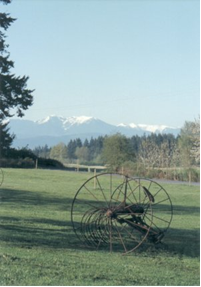
The United States part of the UN Biosphere Reserve program is run by a committee of ten federal agencies with no congressional direction or authorization. Over 68% of our National Parks, Preserves, and Monuments are designated as a United Nations World Heritage Site, a Biosphere Reserve, or both. “Biosphere reserves are areas of terrestrial and coastal ecosystems promoting solutions to reconcile the conservation of biodiversity with its sustainable use”, says the UN.
Biospheres, I learned, consist of a “core” area, where no man is allowed to go (except perhaps a few “elite” scientists/pseudo-scientists); a buffer area, and small community areas where people are allowed to live (so-called “smart growth” being perpetrated under the unpopular Growth Management Act). If you look at a map of the Olympic Peninsula, you’ll see that there is only a strip of land remaining now, where people live – and that private land is increasingly encumbered with restrictive regulations of one sort or another. I have spoken to several individuals who tell me they’ve seen a Park Service map where a 20 year plan shows the park has eaten up most of the remaining area, including Forks, Port Angeles, and most of Clallam County. Not having seen it myself, it will be interesting to see if this takes place.
A few years ago, Penny Eckert, Ph.D. candidate from the University of Washington’s College of Forestry was a featured speaker at one of our “watershed council” [Dungeness River Management Team (DRMT)] meetings. Her dissertation, funded by the State of Washington Department of Ecology, was on changes in land use and ownership in the Dungeness Valley, 1981 through 1994. Asked why she had chosen the Dungeness Valley for her study area, Penny responded that proximity of the valley to a Biosphere Reserve was largely the contributing factor.
Biosphere Reserves, Eckert told the audience, are core areas and should have buffers. This reserve [the Olympic Mountains and the surrounding area, where we live] doesn’t have those buffers, she said. Therefore, information about land use in areas where these buffers would otherwise be must be known for comparison with other Biosphere Reserves, she stated.
Enter the Governor’s “Sustainable Washington”. We must become “sustainable,” says he. In fact, the governor was presented an award reflecting that Washington state is the 5th most sustainable state in the union, but “we can never define precisely what ‘sustainable’ means. We have to discover – and invent- its meaning as time passes,” he states. Terms like “conflict resolution” are used to “forge a sense of community.” Examples of a “sustainable” Washington is a state where “single occupancy vehicles” will be gone, and people will be “living in smaller communities," touts the governor’s website. Nebulous, meaningless terms are used. But words do have meanings. We can see the meaning of “sustainability” by learning what the UN folks tell us what is NOT sustainable.
Here’s what Maurice Strong, socialist, senior adviser to the Commission on Global Governance and driving force behind the concept of “sustainability”, said when introducing the term at the 1992 Rio Conference (Earth Summit II): Industrialized countries [Americans] have “developed and benefited from the unsustainable patterns of production and consumption which have produced our present dilemma. It is clear that current lifestyles and consumption pattern of the affluent middle class – involving high meat intake, consumption of large amounts of frozen and convenience foods, use of fossil fuels, appliances, home and work-place air-conditioning and suburban housing – are not sustainable. A shift is necessary toward lifestyles less geared to environmentally damaging consumption patterns.” Strong also explains in an essay that the concept of sovereignty has to yield in favor of the “new imperatives of global environmental cooperative.”
In the vision statement for a sustainable future, linked to the governor’s website, we’re told to “think globally and act locally.” We are in the process of becoming “global” citizens, rather than citizens of our state and our own nation. It’s a world government in the making.
The concept of “sustainability” is, in fact, nothing less than socialism. Our governor points to a wonderful speech made by the governor of Oregon. Governor Kitzhaber's (Oregon) Sept. speech for the Sustainability Forum are called “inspiring words” by our Governor Locke. Here are a couple of items from that speech: “Let us remember that the word ‘politics’ derives from the Greek word ‘polis,’ meaning “city” – or in more modern terms, “community.’ That is to say, a group of individuals functioning together as a whole for the mutual benefit.” (group think)… “Our political system – or perhaps more accurately, our system of governance – grew out of the recognition that there had to be some way to regulate the ways in which people interact, precisely because their views, needs and interests would not always coincide.
“And of course this implies that individuals have an equally important duty: they have to recognize that their own personal welfare is inseparable from the welfare of the community as a whole, and they must be willing to act accordingly, even if it means subordinating some of their own personal desires for the larger good.”
e goes on to talk about the “gap” in government – and the solution to filling the “gap” he says, in the case of water issues (he referred to Klamath and the conflicts there in this speech) is the “watershed council.” For “livable communities,” it’s the “Community Solutions Team.” A local business person here has advised me there is a new group forming here to develop “low impact” housing. The goal is sustainability. The group will, no doubt, be using the “consensus” process to achieve their predetermined outcomes.
What he’s actually talking about here are “soviets” – those groups used in the Soviet Union to control the people. One has only to read the communist manifesto to see how far down that road we’ve gone.
We are faced with a “recession” in our area now, especially in the Forks area, where the spotted owl has virtually killed the economy. Residents have been given the choice of relocating or retraining – and the retraining consists primarily of three choices: massage therapist, law enforcement, or drug and alcohol counselor.
Bit by bit, the property is being removed from private ownership and placed into “public” ownership. The public, however, in many cases, is closed off from access to the “public” land by way of gates and designated “wilderness” areas. The Port Angeles area is also in a state of recession.
So what does sustainability aka socialism, have to do with the Olympic Mountains where I live? It is clear to see, upon reviewing very few documents, that we are quickly losing our sovereign nation that our founding fathers fought so hard to get, and our young men and women through the years have fought and died to keep. Whether it be through United Nations’ designations (with the strings attached) or the United Nations idea of “sustainability” – we are being directed into a one world government.
Most people who live here don’t even think about the UN designations of our mountains. “It’s so nice,” they say, “that our mountains are so wonderful that they have been noticed worldwide.” But where there’s a designation, there’s also a certain power to control what takes place. In recent years, the Olympic Mountain goats were killed off, because they were considered “non-native.” One only has to look at the UN’s involvement in Yellowstone Park to see the “nose under the tent”, so to speak. The challenge is to wake Americans to the fact that we are losing our sovereignty, piece by piece.
On the Olympic Peninsula, however, there is a growing number of citizens who are awakening to the facts about biospheres and sustainability, and who are getting involved politically to try and turn the tide. Do you see this happening in your area?